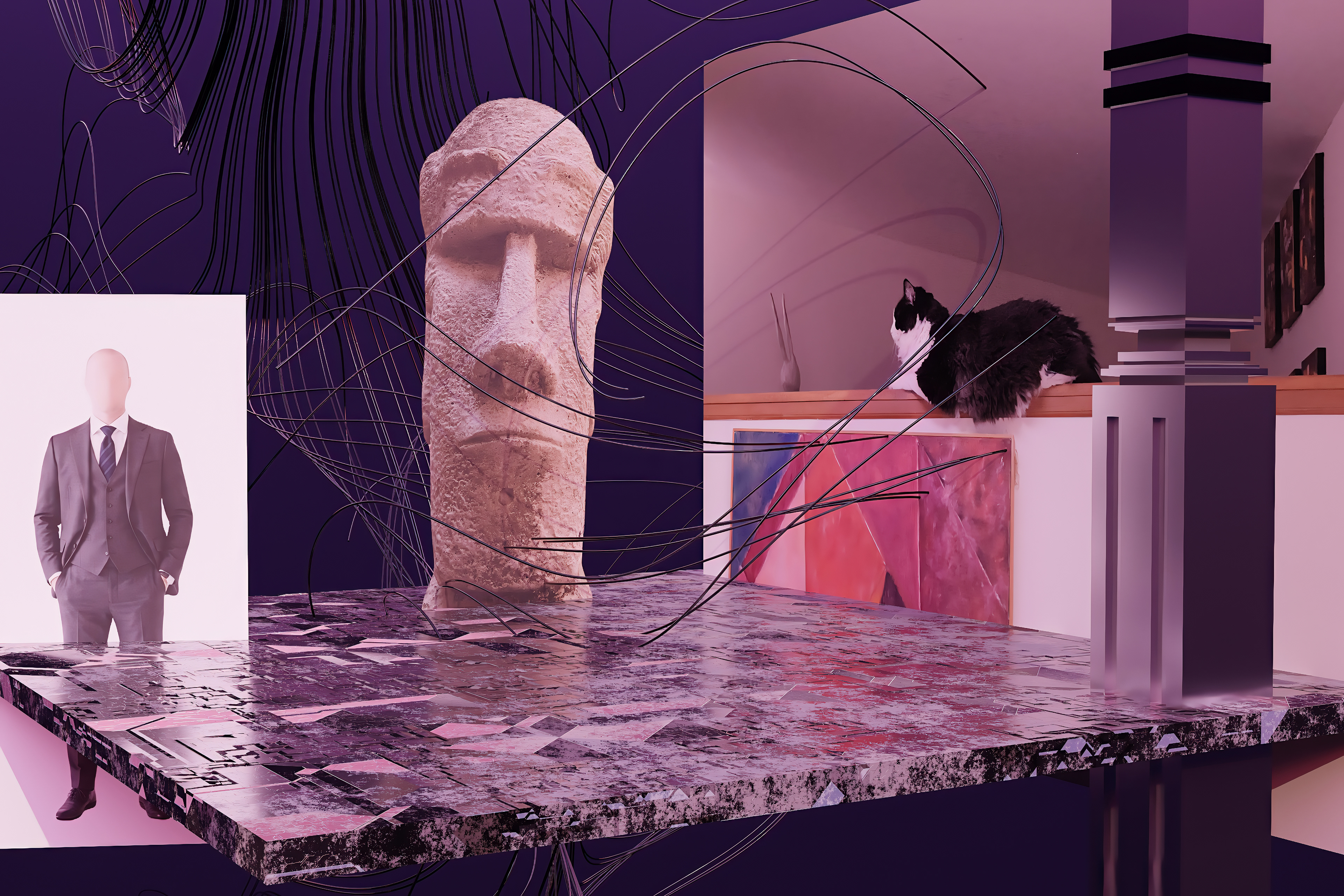
One element of this was AI generated - does that fact make this image AI slop?
Introduction
I've been watching the AI discussion unfold, and it's often felt like a schoolyard rocks/sucks argument. Apparently, art that makes use of AI is either garbage or amazing with very little in between. As someone who's spent a good chunk of my life knee-deep in paint, pixels, and photographs, I wanted to get past the enormous amount of heat generated around this topic and to try and find some light. My main focus here isn't on whether AI art has aesthetic merit (that's a subject I picked at elsewhere) but whether accusations of copying and theft are more relevant with regard to AI than with any other medium that an artist may choose.
A word of warning: this isn't going to be one of those perfectly balanced, "on the one hand, on the other hand, carefully balanced conclusion" NPR style pieces that ties everything up nicely and puts a neat little bow on top. What I've tried to do here is pull together thoughts from conversations with fellow visual artists along with some online articles and their attached comments.
Copying and stealing is what we do
Every single visual artist copies. The idea that you can create a 100% gold-plated original piece of visual art is a fantasy. Picasso nailed it when he (supposedly) said: "Good artists copy; great artists steal." You hear variations of this across pretty much every creative field. Luminaries such as William Faulkner, Steve Jobs, T.S. Eliot and more have all expressed similar thoughts to those stated by Picasso.
What I find striking about the current outcry against AI, particularly the furious "Any use of AI is theft" comments you see everywhere online, is the lack of historical perspective. Many of these passionate keyboard warriors, who would benefit from a deeper understanding of art history (and maybe a touch of humility regarding their own work), declare that all AI output is derivative slop, end of story.
The irony? Often, the work these critics are sharing on their own profiles is second hand in some if not every way. The most obvious examples are anime that is a straight rip off of another artist's style, paintings created as an exact copy of a photograph, Sci Fi 3D renders that are stylistically identical to whatever movie is currently trending. There are many more examples, these are just the first three that came to mind. The only real question is whether the 'artist' is under the illusion that they are producing original and important work or not. The ones that think they are true originals are the most worrying in my opinion.
Of Niches and Temperament
I've noticed something interesting when I look at the people championing AI versus those vehemently against it. Artists who have really niched down their practice – think super-specialized – are far more likely to be anti-AI. On the flip side, those who work across a wider range of mediums, styles, and subjects tend to be more open.
I think there are two main reasons for this split:
1) Financial Vulnerability: If you've poured years of your life, effort, and money into building a business in a niche market where demand is high and supply is low, AI tools that can suddenly generate similar aesthetics or content are a direct threat. They can undermine your carefully built business model, potentially making your specialized skills less valuable, or even obsolete. That's a scary place to be.
2) How We Handle Change: Beyond the money, I see a fundamental difference in temperament. Some artists, myself included, get energized by the potential of new technologies. We see them as exciting new frontiers for creativity. Others, however, are primarily driven by a fear of obsolescence. They view technological advancements as existential threats to their established methods and livelihoods.
In my experience the artists who deal with change the best are the process driven ones, the ones that don't have an exact finished piece in mind when they start but rather allow for each stage to determine the next. The more goal driven artist has a very definite end product in mind and every part of the process is determined by the desired end goal. I place myself very strongly in the former category and that is why I am a much better artist than illustrator.
I had a good friend who was an excellent book illustrator and we used to discuss this topic on occasion. We both agreed that we could not do what the other did if our lives depended on it. She could no more fill a canvas without days of prep/reference work than I could produce an technically involved illustration based on days of research and a level of draftsmanship that was and still is beyond me.
While I can absolutely sympathize with anyone who's spent years building a visual arts career only to face potential redundancy from advances in technology, the current reality demands adaptability. Success in any field is often a hard slog with no guarantees. But here's the thing: having a broader artistic foundation makes pivoting much easier than having to rebuild from scratch. The one certainty we have is that technology will make current ways of operating obsolete; it's not a question of if, but when. This isn't a new story. Years ago, photographers groaned about how digital cameras and editing software lowered the barrier to entry, making it "too easy" for non-professionals to earn money, long before AI even entered the conversation.
My Approach
I do not regard myself as either pro or anti the use of AI in art. You may as well ask me if the camera, computer, or even a paintbrush is a valid tool - the question just doesn't make sense to me. It is something out there in the real world therefore it is something that can be incorporated into the artistic process. Now to extend this; if I put one of my creations out into the world (or even just onto my hard drive) then it is part of the world and therefore should be free to be used by others for their own artistic process. This reasoning has led me to release over four thousand images into the public domain, and I genuinely couldn't care less how they're used or if someone else profits from them. These are images that would otherwise just sit dormant on a backup hard drive, serving no purpose.
My perspective is deeply rooted in post-modern thought: I honestly believe there's "nothing new under the sun." Our job as artists, as I see it, is mostly to take what's come before and juxtapose it, recontextualize it. When I look at almost any visual work now – my own or someone else's – I can see the influences staring right back at me.
This conviction means I'm personally not fussed about whether a piece or project I'm working on is "original." If something resonates with me, I pursue it; if it doesn't, I move on. Originality is the furthest thing from my mind. Now, if I did create something and later realized it was too close to another artist's work, I'd certainly hold back from releasing it publicly. There's a gray area there, but often, it's a "you know it when you know it" kind of call. That scenario is also pretty rare, because overly derivative work quickly loses its appeal to me.
No putting the toothpaste back in the tube
The whole AI and originality debate in visual art desperately needs a more nuanced, historically informed discussion. By åacknowledging the long, long traditAion of artistic borrowing and the subjective nature of what we even mean by "originality," we can hopefully move beyond the knee-jerk accusations of theft. The challenges AI presents are absolutely real, especially for those whose livelihoods are directly impacted. But the solution isn't to fight against inevitable technological progress. Instead, it lies in fostering adaptability, exploring new creative avenues, and engaging with these powerful new tools in ways that expand human artistry, rather than diminishing it.
AI is here and it isn't going anywhere, so as with the camera and the computer, this whole discussion is pretty much academic. As artists we have two choices, either do something else with our time/lives or buckle up and enjoy the ride. There is no third option, artificial intelligence in art as in life is here to stay.
I am an optimist, technology moves forward all the time and, to my recollection, art has never ended up poorer as a result of that fact. Sure, art will be different but it won't be worse.
By Steve A Johnson
Originally published Sept 2026 on Medium but is no longer live there or anywhere other than here (as far as I know)